







ISFP – "The Non-Confrontational Sensitive"
A creative, people-oriented introvert with a predominance of feeling, without major ambitions or readiness to enter confrontation
Prevalence of ISFP in the population
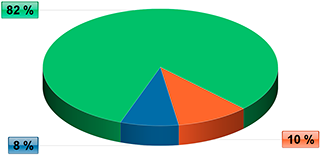
 — Women
 — Men
— Men
 — Everyone else
I – Introversion S – Sensing F – Feeling P – Perceiving
ISFPs use feeling as their dominant function. They are primarily interested in reality as mediated through the senses, both external and internal. They never prepare or plan ahead; they know how to be kind and are sensitive to the pain and suffering of others. They need to feel the plus points — through touch, in their muscles, through eyes, ears, taste. They are drawn to occupations where they can apply their ability to discern even very subtle differences with their senses. ISFPs are strong especially in many artistic fields; what matters most for the breadth of their career choices is finishing school, which is the hardest thing of all for them, since school as an institution offers them little that interests them and does nothing to stir their particular kind of intelligence into action. Placing them somewhere they must perform routine, unexciting, endlessly repeating tasks according to fixed rules is almost like a prison sentence for them. To be content and productive, they instead need freedom of choice, variety in their activities, and to be praised for how well they handle things. In the world of management they are a very rare species, typically having remarkably little ambition to stand above someone or even give orders. Above all they want to help, to be useful, and to a degree that can arouse suspicion in others, even though they have no ulterior motive. In leadership positions they often appear as compromise candidates. Conflict-laden environments don't suit them, and they shy away from such situations. They often don't know what to do with a pile of deadlines, due dates for this or that, and other pressures. They also struggle with consistency. They tend to thrive instead where they can be effective at finding solutions to thorny matters, especially ones that have gotten stuck because of poor human relationships. They are also good where people need support, a kind word, or a good deed — being listened to, being allowed to speak their mind, and so on.
Working with an ISFP?
✅ Their specific kind of intelligence doesn't suit a sterile administrative environment.
✅ They need positive feedback and variety in their activities.
✅ View their somewhat awkward expressions of willingness to help with understanding — they mean it sincerely.
✅ They are capable of breaking through seemingly insurmountable barriers in communicating with people.
✅ When it comes to time management, they need a co-worker's help — this type is incorrigible in that regard.
✅ No need to worry about excessive ambition; they know how to fall in line without grumbling.
✅ They are solvers rather than managers.
Type by function in society, i.e. temperament: PLAYERS - ARTISANS (SP – fire) (27% of the population)
They live in the here and now, reacting quickly and impulsively to new stimuli through their senses. They tend to be skilled and talented. What matters to them is activity, action, and intense experiences. They prefer to work "on their own" rather than within large organizations. Symbolically they correspond to the element of fire.
✓ realistic and flexible
✓ create best (with their hands) right here and now, in real time
✓ can't stand routine, it bores them
✓ can seem unreliable to others
✓ need to believe that the ideas presented are realistic
✓ need freedom and space, otherwise they lose motivation
16 Personality Types Compatibility Chart
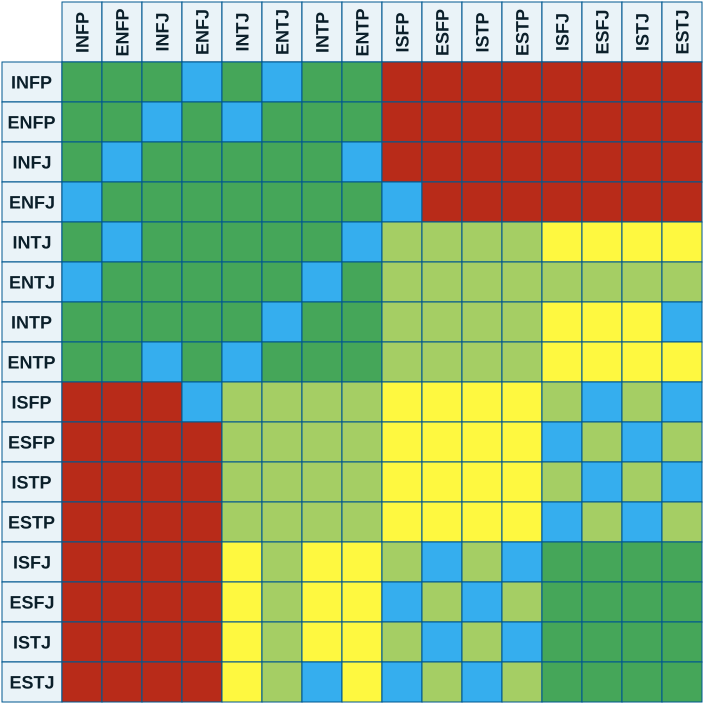
Legend:
 — Least ideal
 — Conflicting
 — One-sided compatibility
 — Strong compatibility (requires some compromise)
 — Ideal compatibility